History, Impact, and Indigenous Resilience (1884–1934)
Project Overview
Thesis: The Genoa U.S. Indian Industrial School is a clear example of how federal boarding school policies attempted to erase Indigenous identity through forced assimilation, while also revealing the resilience of Native students who found ways to survive and resist despite these conditions.
This project focuses on the history and long-term impact of the Genoa U.S. Indian Industrial School, one of the largest federal boarding schools in the United States. Located in Nebraska, Genoa operated from 1884 to 1934 and enrolled thousands of Native children from tribes across the Midwest and Great Plains, including the Omaha Tribe and many neighboring nations.
Boarding schools like Genoa were not created to simply educate Native children. They were designed to separate children from their families, suppress Indigenous languages and traditions, and reshape students into members of Euro-American society. While these schools caused severe cultural, emotional, and physical harm, they also became places where Native children formed connections and quietly resisted assimilation.
By examining historical policies, daily life at Genoa, survivor testimonies, and modern investigations, this website shows how the legacy of boarding schools continues to affect Native communities today through intergenerational trauma, language loss, and ongoing efforts toward healing.
Historical Background
The Native American boarding school system developed during the nineteenth century as part of the U.S. government’s broader effort to control Indigenous peoples and force assimilation. As westward expansion increased, federal officials viewed Indigenous cultures as obstacles to progress rather than communities with their own systems of knowledge and governance.
The Indian Civilization Fund Act of 1819 provided federal funding to religious organizations to educate Native children according to Euro-American values. This was followed by the Peace Policy of 1869, which expanded government and church involvement in Native education. Together, these policies created the foundation for off-reservation boarding schools.
The Carlisle Indian Industrial School, founded in 1879, became the model for schools across the country. Its philosophy emphasized total cultural transformation, an approach that was later applied at Genoa with similar consequences.
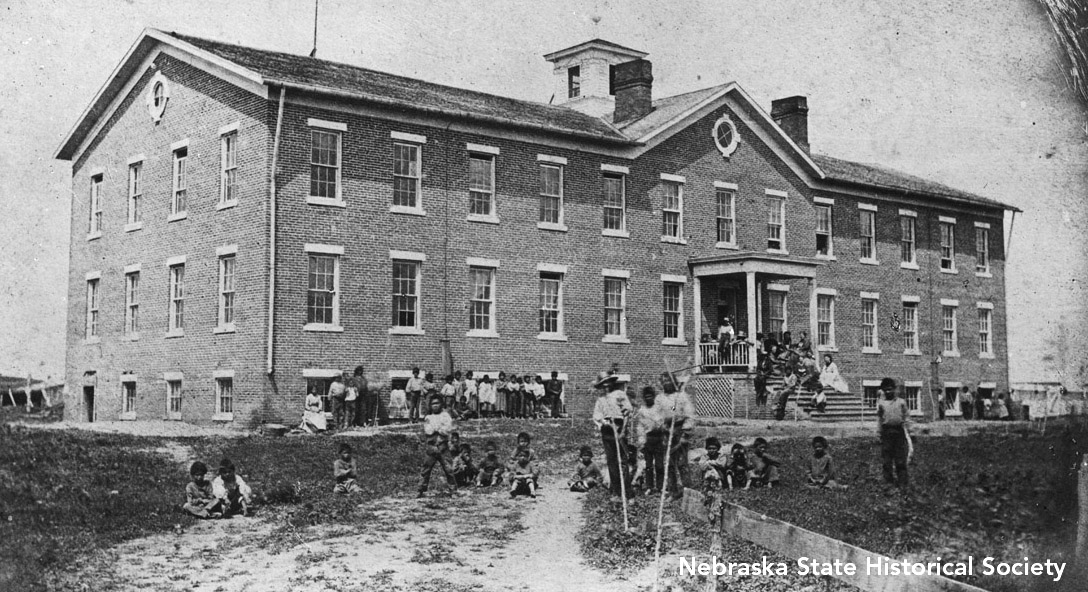
Exterior view of the Genoa U.S. Indian Industrial School.
Timeline of the Genoa Boarding School
1819: Indian Civilization Fund Act establishes federal support for assimilation through education.
1869: Peace Policy increases federal control over Native life and schooling.
1879: Carlisle Indian Industrial School opens and becomes the national model.
1884: Genoa U.S. Indian Industrial School opens in Nebraska.
1880s–1920s: Thousands of Native children from over 40 tribes attend Genoa.
1934: Genoa closes as federal Indian policy begins to shift.
2022–Present: Federal investigations and healing initiatives renew attention on boarding school history.
Key Facts About Genoa
Operated from 1884 to 1934
Fourth-largest federal boarding school in the United States
Students came from more than 40 tribal nations
Many students were sent far from their home communities
Education focused heavily on labor and vocational training
The site is now preserved through a museum and digital archives
Life at the Genoa Boarding School
Daily life at Genoa was highly structured and strictly enforced. Students followed military-style schedules that left little room for personal freedom. Many children were separated from their families for years, with limited opportunities to visit home or communicate freely.
Education at Genoa prioritized labor over academic learning. Boys were often assigned to farming, maintenance, or trades, while girls were trained in domestic work such as cooking, sewing, and laundry. This labor was essential to keeping the school running and often replaced meaningful classroom instruction.
While school officials claimed these practices prepared students for life in American society, they frequently denied children a full education and exposed them to exhausting and harsh working conditions.
Assimilation and Abuse
Genoa followed the assimilation ideology promoted by Richard Henry Pratt, commonly summarized as “Kill the Indian, save the man.” This belief justified the forced removal of Indigenous identity under the guise of education.
Students were punished for speaking their Native languages, practicing their traditions, or resisting authority. Many experienced physical punishment, emotional abuse, neglect, illness, and malnutrition. These conditions caused long-lasting harm that extended far beyond a student’s time at the school.
Resistance and Survival
Despite the goal of total assimilation, students at Genoa found ways to resist and support one another. Resistance often took quiet forms, such as secretly speaking Native languages, maintaining cultural practices, or forming strong friendships.
Survivor testimonies and letters reveal that these acts of resistance were critical for emotional survival. They allowed students to preserve a sense of identity and belonging in an environment designed to erase both.
“They tried to make us forget who we were, but we always remembered.”
Long-Term Impacts
The effects of the Genoa Boarding School did not end when the school closed. Many former students returned to their communities carrying trauma that disrupted family structures, parenting practices, and the transmission of language and culture.
Intergenerational trauma linked to the boarding school system continues to affect Native communities today. Recent investigations have also brought attention to student deaths and unmarked graves, highlighting the physical dangers these institutions posed.
Healing and Legacy
Indigenous communities continue to work toward healing through cultural revitalization, education, and truth-seeking efforts. Museums, digital archives, and advocacy organizations play an important role in preserving survivor stories and educating the public.
Federal initiatives, such as the U.S. Department of the Interior’s Boarding School Initiative, represent steps toward accountability and acknowledgment of the harm caused by boarding schools.
Conclusion
The history of the Genoa U.S. Indian Industrial School shows how education was used as a tool of forced assimilation rather than empowerment. The harm caused by these institutions continues to affect Native communities, but so does the resilience of those who survived them.
Understanding Genoa’s history is essential not only for recognizing past injustices, but also for supporting ongoing efforts toward healing, cultural preservation, and accountability.